
EtG vs Alcohol Breath Test: What Is the Difference
author: Antonmed
2026-09-20
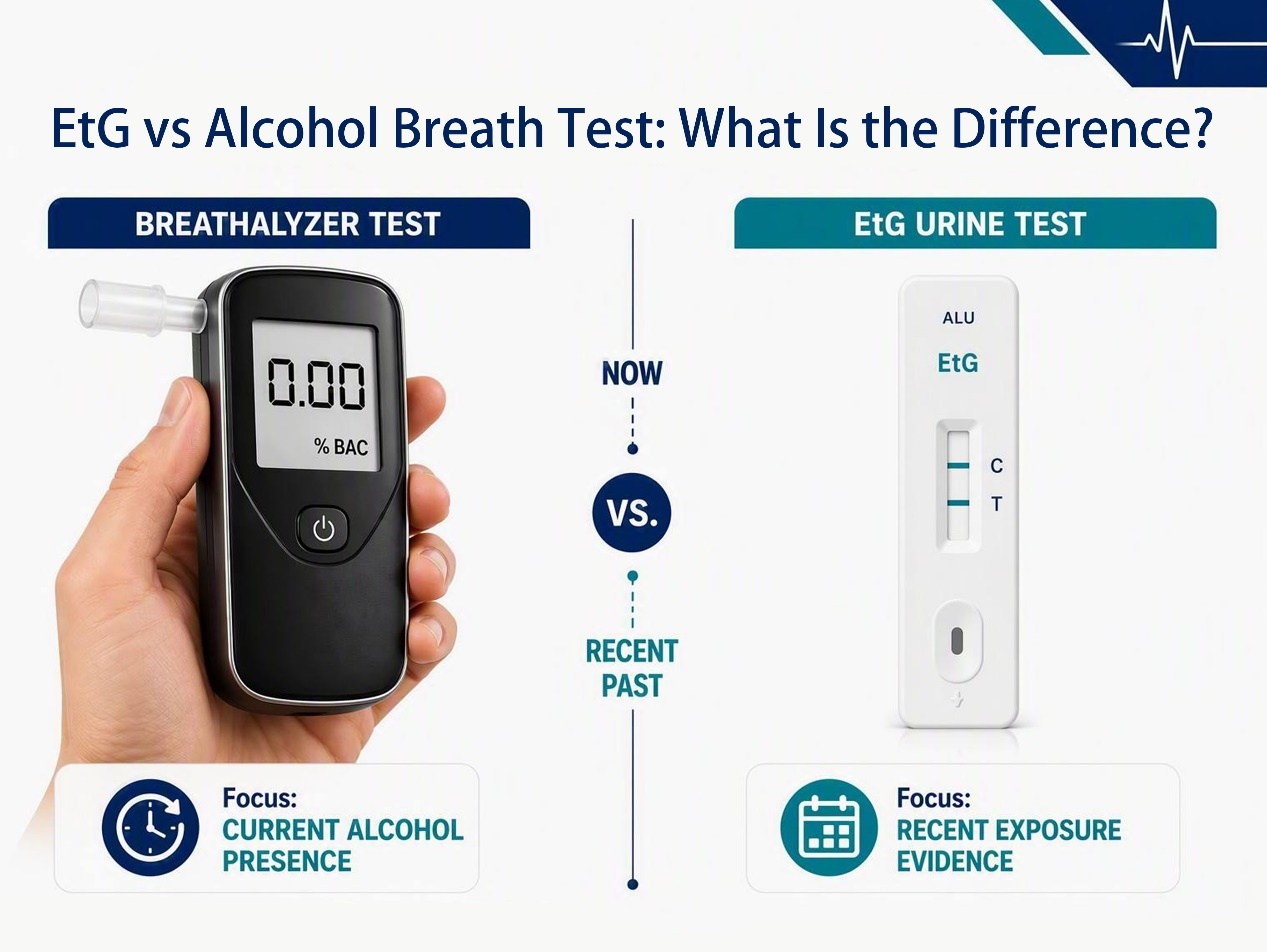
When choosing an alcohol test, it is easy to assume that an EtG urine test and an alcohol breath test are simply two different ways of measuring the same thing. They are not. Although both are used in alcohol-related screening, they detect different biomarkers and are intended to answer different questions.
An alcohol breath test, commonly referred to as a breathalyzer test, measures ethanol in exhaled breath. It is therefore primarily concerned with alcohol that is present in the body around the time of testing. An EtG urine test measures ethyl glucuronide (EtG), a metabolite produced when the body processes ethanol. Because EtG can remain in urine after ethanol itself is no longer detectable, urine EtG testing generally provides a longer window for identifying recent alcohol exposure.
This is the most useful way to understand the difference. A breath alcohol test is mainly about current alcohol presence, while an EtG test is about evidence of recent alcohol exposure. Neither test is simply a more accurate version of the other.
An alcohol breath test, commonly referred to as a breathalyzer test, measures ethanol in exhaled breath. It is therefore primarily concerned with alcohol that is present in the body around the time of testing. An EtG urine test measures ethyl glucuronide (EtG), a metabolite produced when the body processes ethanol. Because EtG can remain in urine after ethanol itself is no longer detectable, urine EtG testing generally provides a longer window for identifying recent alcohol exposure.
This is the most useful way to understand the difference. A breath alcohol test is mainly about current alcohol presence, while an EtG test is about evidence of recent alcohol exposure. Neither test is simply a more accurate version of the other.
What Are EtG and Alcohol Breath Tests Actually Measuring?
The biological difference starts with what happens after alcohol is consumed. Ethanol is absorbed into the bloodstream and distributed throughout the body. A portion of it reaches the lungs and is released through exhaled air, which makes breath alcohol testing possible. A breathalyzer measures this alcohol in the breath and provides an indication of alcohol concentration at the time of testing.
The biological difference starts with what happens after alcohol is consumed. Ethanol is absorbed into the bloodstream and distributed throughout the body. A portion of it reaches the lungs and is released through exhaled air, which makes breath alcohol testing possible. A breathalyzer measures this alcohol in the breath and provides an indication of alcohol concentration at the time of testing.
EtG testing follows a different biological pathway. When the body metabolizes ethanol, a small amount is converted into ethyl glucuronide. EtG can subsequently be excreted in urine and remain detectable after the original alcohol has disappeared from the bloodstream.
That difference explains an important situation that often causes confusion: a person can have a negative breath alcohol test and a positive EtG urine test.
That difference explains an important situation that often causes confusion: a person can have a negative breath alcohol test and a positive EtG urine test.
For example, if alcohol was consumed the previous evening, the ethanol concentration may have fallen below the detection range of a breathalyzer by the following day. EtG produced during the metabolism of that alcohol may still be present in urine. The two results are therefore not necessarily contradictory; they reflect two different stages of alcohol detection.
Mayo Clinic Laboratories notes that alcohol itself is normally detectable in urine for only a few hours, while EtG may be detectable for approximately one to three days in its urine screening context. However, this should not be interpreted as a fixed detection period for every person or every EtG product. Detection depends on factors including the amount and timing of alcohol exposure, the analytical method, the cutoff used, and the characteristics of the urine sample.
Mayo Clinic Laboratories notes that alcohol itself is normally detectable in urine for only a few hours, while EtG may be detectable for approximately one to three days in its urine screening context. However, this should not be interpreted as a fixed detection period for every person or every EtG product. Detection depends on factors including the amount and timing of alcohol exposure, the analytical method, the cutoff used, and the characteristics of the urine sample.
This is also why professional discussions about EtG detection windows should avoid statements such as “EtG always detects alcohol for 72 hours.” A more accurate description is that EtG generally provides a longer detection window than direct ethanol testing, with the actual window varying according to the test and testing conditions.

EtG vs Breathalyzer: Which Test Is Better?
There is no meaningful answer without first defining what the test is supposed to tell you.
If the objective is to determine whether alcohol is present at the time of testing, breath alcohol testing is generally the more direct approach. The sample is easy to collect, the test can be performed immediately, and the result is designed around current alcohol presence. This is why breathalyzers are commonly associated with roadside testing, workplace screening, and other situations where an immediate assessment is required.
There is no meaningful answer without first defining what the test is supposed to tell you.
If the objective is to determine whether alcohol is present at the time of testing, breath alcohol testing is generally the more direct approach. The sample is easy to collect, the test can be performed immediately, and the result is designed around current alcohol presence. This is why breathalyzers are commonly associated with roadside testing, workplace screening, and other situations where an immediate assessment is required.
EtG urine testing serves a different purpose. It can be useful when the question concerns alcohol exposure that occurred earlier and the alcohol itself may no longer be detectable. This makes EtG relevant in certain alcohol monitoring and screening applications where a longer detection window is important.
It would therefore be misleading to describe EtG as "more accurate than a breathalyzer" or a breathalyzer as "better than EtG." The appropriate comparison is between intended use, detection target, and detection window.
There is another important distinction for professional users. A rapid EtG urine test is generally a screening method, not a direct measurement of intoxication. A positive screening result indicates that EtG may be present above the test's cutoff; it does not establish that the individual is currently impaired or intoxicated.
Where confirmation is required, laboratory methods such as liquid chromatography-tandem mass spectrometry (LC-MS/MS) may be used. Mayo Clinic Laboratories, for example, uses immunoassay for its EtG screening test and LC-MS/MS for confirmation.
Where confirmation is required, laboratory methods such as liquid chromatography-tandem mass spectrometry (LC-MS/MS) may be used. Mayo Clinic Laboratories, for example, uses immunoassay for its EtG screening test and LC-MS/MS for confirmation.

How Long Does EtG Stay in Urine?
The question of how long EtG remains detectable is one of the main reasons people search for EtG vs. breathalyzer information in the first place.
The question of how long EtG remains detectable is one of the main reasons people search for EtG vs. breathalyzer information in the first place.
EtG can remain in urine considerably longer than ethanol itself, but there is no single detection window that applies to all EtG tests. A result depends not only on when alcohol was consumed but also on the amount consumed, urine concentration, the assay's cutoff, and the analytical technology used.
For a common EtG screening context, Mayo Clinic Laboratories describes a detection window of approximately one to three days. Its laboratory confirmation information also describes EtG and EtS detection for up to five days under specific testing conditions and a 500 ng/mL cutoff.
These numbers should be understood as laboratory guidance rather than a guarantee for an individual test. In particular, a longer detection window does not mean that an EtG result can tell you exactly when alcohol was consumed or how much was consumed.
Cutoff selection is therefore an important part of EtG testing. A lower cutoff can allow detection of lower concentrations of EtG, but sensitivity should always be considered together with the intended application and interpretation of results. Buyers comparing different EtG urine test kits should look at the actual cutoff and performance data rather than choosing a product simply because its marketing describes it as "high sensitivity."
The testing environment also matters. EtG is sensitive to alcohol exposure, and interpretation of low-level results may require consideration of incidental exposure from alcohol-containing products. For this reason, a professional EtG testing program should define how screening results are interpreted and when confirmation testing is required.
Cutoff selection is therefore an important part of EtG testing. A lower cutoff can allow detection of lower concentrations of EtG, but sensitivity should always be considered together with the intended application and interpretation of results. Buyers comparing different EtG urine test kits should look at the actual cutoff and performance data rather than choosing a product simply because its marketing describes it as "high sensitivity."
The testing environment also matters. EtG is sensitive to alcohol exposure, and interpretation of low-level results may require consideration of incidental exposure from alcohol-containing products. For this reason, a professional EtG testing program should define how screening results are interpreted and when confirmation testing is required.
What Does This Difference Mean for EtG Test Kit Buyers?
For an individual using a single alcohol test, the decision may be relatively straightforward. For a healthcare organization, distributor, importer or diagnostic brand, choosing an EtG test kit manufacturer involves a much broader set of considerations.
The first question should be whether the product is actually suitable for the intended application. The buyer should understand what the assay detects, its cutoff, sample requirements, reading time and stated intended use. After that come the practical issues that affect commercial supply: manufacturing consistency, quality control, packaging, documentation, storage and transportation stability, and the supplier's ability to support repeat orders. This is where the difference between buying a test and choosing a manufacturer becomes important.
For an individual using a single alcohol test, the decision may be relatively straightforward. For a healthcare organization, distributor, importer or diagnostic brand, choosing an EtG test kit manufacturer involves a much broader set of considerations.
The first question should be whether the product is actually suitable for the intended application. The buyer should understand what the assay detects, its cutoff, sample requirements, reading time and stated intended use. After that come the practical issues that affect commercial supply: manufacturing consistency, quality control, packaging, documentation, storage and transportation stability, and the supplier's ability to support repeat orders. This is where the difference between buying a test and choosing a manufacturer becomes important.
Antonmed focuses on IVD and POCT products and works with international customers on rapid diagnostic products and OEM/ODM requirements. For a company looking for a rapid EtG test supplier, private-label EtG urine test or customized alcohol screening product, the discussion should not stop at the unit price. Product specifications, manufacturing consistency, packaging requirements and documentation are all part of the supplier evaluation.
For international B2B buyers, this can be particularly important because the requirements for selling an IVD product can vary between markets. A supplier should therefore be able to clearly explain the product's specifications and intended use and provide the documentation relevant to the customer's market and regulatory pathway.

So, Which Alcohol Test Should You Use?
The simplest answer is to start with the question you actually need the test to answer.
If you need to know whether alcohol is present at the time of testing, a breath alcohol test is generally the more appropriate choice. If you need to identify evidence of recent alcohol exposure after ethanol itself may no longer be detectable, an EtG urine test may provide more useful information.
The simplest answer is to start with the question you actually need the test to answer.
If you need to know whether alcohol is present at the time of testing, a breath alcohol test is generally the more appropriate choice. If you need to identify evidence of recent alcohol exposure after ethanol itself may no longer be detectable, an EtG urine test may provide more useful information.
The distinction can be summarized without reducing the science to a complicated comparison:
Breath alcohol testing focuses on ethanol that is present now. EtG urine testing focuses on a metabolite that can remain after alcohol has been processed by the body. That is why an EtG test can remain positive after a breathalyzer becomes negative, and why neither method should automatically be described as “better.”
Breath alcohol testing focuses on ethanol that is present now. EtG urine testing focuses on a metabolite that can remain after alcohol has been processed by the body. That is why an EtG test can remain positive after a breathalyzer becomes negative, and why neither method should automatically be described as “better.”
For consumers, the intended use should guide the choice. For healthcare providers and testing programs, the testing protocol and interpretation criteria are equally important. And for distributors or diagnostic companies evaluating an EtG urine test manufacturer, the product's analytical characteristics, quality documentation and manufacturing capability should be considered alongside price and delivery time.
Ultimately, the right alcohol test is not necessarily the one with the longest detection window or the fastest result. It is the one that provides the information required for the specific testing purpose.
Ultimately, the right alcohol test is not necessarily the one with the longest detection window or the fastest result. It is the one that provides the information required for the specific testing purpose.
What is EtG Urine Alcohol Test
Urine vs. Blood hCG Tests: What Is the Difference
Related Article
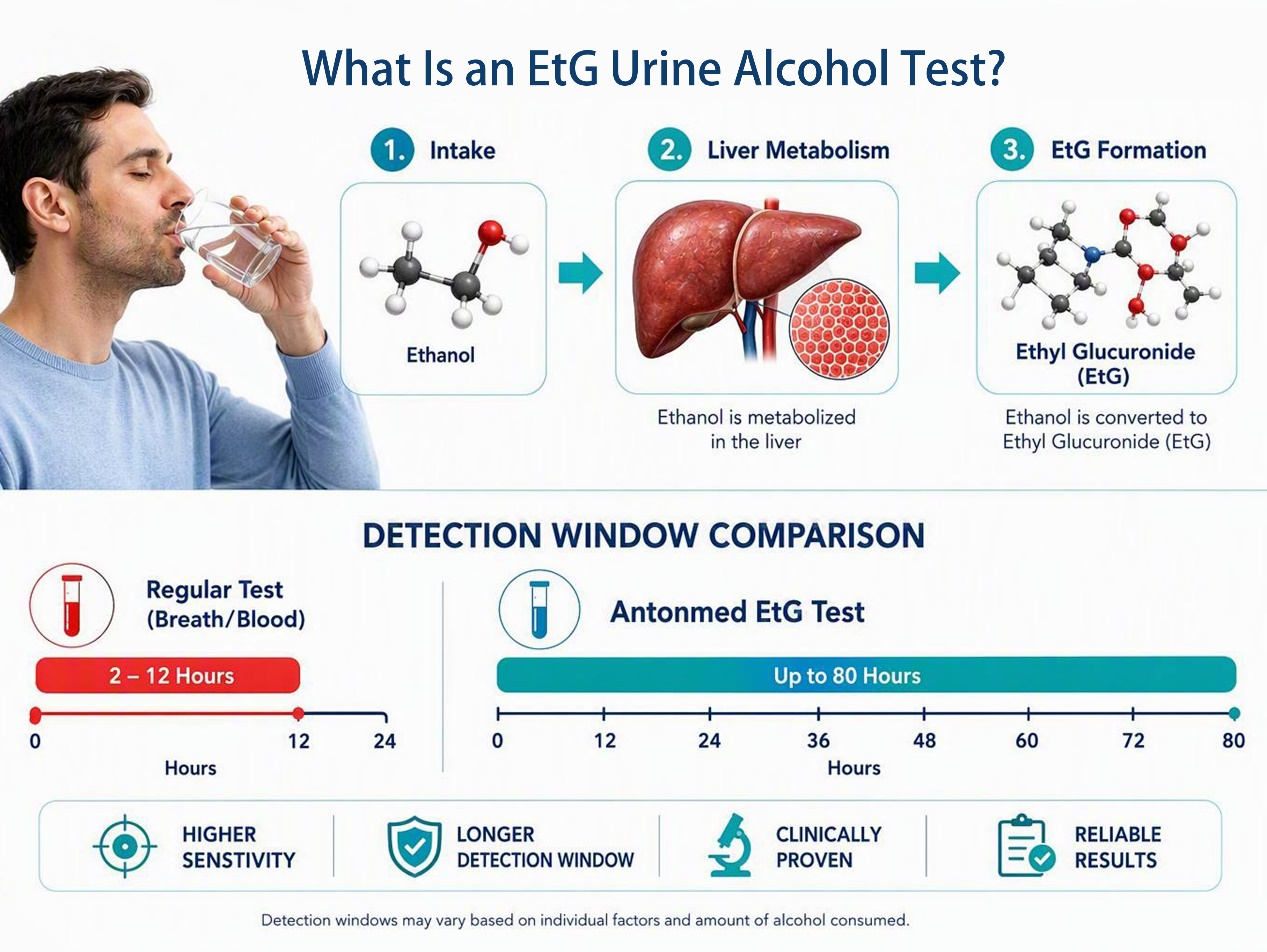
Learn what an EtG urine alcohol test is, how it detects recent alcohol exposure, and what affects its detection window, with EtG testing insights from Antonmed.
What is EtG Urine Alcohol Test
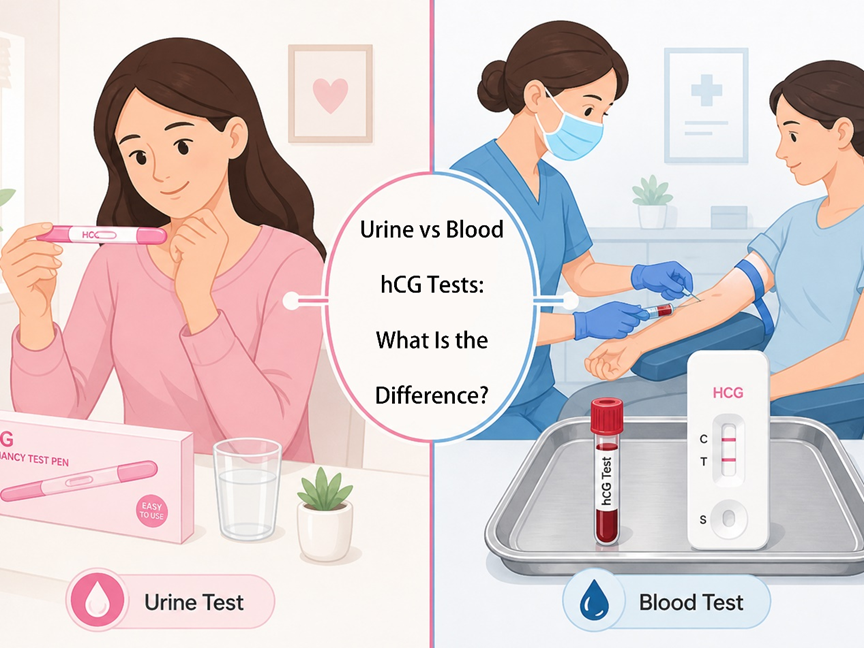
Urine and blood hCG tests both detect human chorionic gonadotropin (hCG), a hormone produced during pregnancy, but they differ in sensitivity, testing methods, timing, and practical use. This article explains the key differences between urine and blood hCG tests and helps readers understand when each testing method may be more appropriate.
Urine vs. Blood hCG Tests: What Is the Difference

Drug abuse remains a global public health and safety concern, making fast and reliable drug screening more important than ever. This article explains what Drugs of Abuse (DOA) are, the most commonly abused substances, how rapid drug tests work, typical detection windows, and the key applications of DOA testing in healthcare, workplaces, rehabilitation centers, and law enforcement.
What Are Drugs of Abuse

Wondering how many times a day you should take an ovulation test? Learn the best testing frequency, when to start using LH ovulation tests, how to avoid missing your LH surge, and tips for improving accuracy. Discover reliable OEM/ODM ovulation test solutions from Antonmed.
How Many Times a Day Should You Take an Ovulation Test