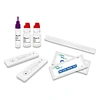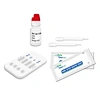
FSH Menopause Test Cassette
ATR06
Antonmed FSH Menopause Test Cassette is a rapid urine-based test designed for the qualitative detection of follicle-stimulating hormone (FSH).
Delivery:
FOB, FCA, DDP
minimum order:
200 pieces
Supply Ability:
100000pieces / Month
Country of Origin:
China
Stock Time:
7Day
Quantity:
Introduction
Antonmed FSH Menopause Test Cassette is a rapid urine-based test designed for the qualitative detection of follicle-stimulating hormone (FSH).
FSH is a hormone produced by the pituitary gland. FSH levels can change during the menstrual cycle and may increase as ovarian function declines during the menopausal transition. Detecting elevated FSH levels in urine can therefore provide useful information related to menopause and perimenopause.
Based on lateral flow immunoassay technology, the Antonmed FSH Test Cassette provides a simple visual testing method without requiring a dedicated analyzer or laboratory equipment.
FSH is a hormone produced by the pituitary gland. FSH levels can change during the menstrual cycle and may increase as ovarian function declines during the menopausal transition. Detecting elevated FSH levels in urine can therefore provide useful information related to menopause and perimenopause.
Based on lateral flow immunoassay technology, the Antonmed FSH Test Cassette provides a simple visual testing method without requiring a dedicated analyzer or laboratory equipment.
The FSH Menopause Test Cassette is based on lateral flow chromatographic immunoassay technology. After the urine specimen is added to the sample well, the liquid migrates through the test membrane by capillary action. If FSH is present at or above the product's specified cut-off level, it reacts with the antibodies and other assay components on the membrane, producing a visible line in the test region.
How to Use the FSH Test Cassette
The exact specimen volume and reading time should always follow the Antonmed Instructions for Use.
1. Collect the Urine Sample
Collect a urine specimen in a clean, dry container according to the product instructions.
Collect a urine specimen in a clean, dry container according to the product instructions.
2. Prepare the Test Cassette
Remove the FSH test cassette from its sealed pouch immediately before testing.
Remove the FSH test cassette from its sealed pouch immediately before testing.
Place it on a clean, dry and level surface.
3. Add the Urine Sample
Use the supplied disposable dropper to transfer the specified number of drops of urine into the sample well marked S.
Use the supplied disposable dropper to transfer the specified number of drops of urine into the sample well marked S.
4. Wait for the Result
Allow the test to develop for the specified reaction time.
Allow the test to develop for the specified reaction time.
5. Read the Result
Interpret the control and test lines according to the Antonmed Instructions for Use.
Interpret the control and test lines according to the Antonmed Instructions for Use.
Do not interpret the test after the specified reading window.