How to Choose an hCG Pregnancy Test Manufacturer
author: Antonmed
2026-08-25

Choosing an hCG pregnancy test manufacturer is not simply a matter of comparing prices or checking whether a supplier has a few popular products. For distributors, importers, clinics, laboratories, and private-label brands, the manufacturer behind the test can directly affect product consistency, regulatory compliance, customer satisfaction, and ultimately the reputation of the business selling it.
With many suppliers offering hCG pregnancy test strips, cassettes, and midstream tests, it can be difficult to tell which manufacturers are genuinely capable of providing stable, reliable products and which are mainly acting as traders. A closer look at their production capabilities, quality management, product performance, and support services can make the decision much easier.
Start With the Product, Not the Price
Price is usually one of the first things buyers compare, but it should not be the starting point.
An hCG pregnancy test is a rapid diagnostic product. Its performance depends on the quality of the antibodies, membrane, reagents, assembly process, and final quality control. Two pregnancy test cassettes may look almost identical while performing differently when used with low hCG concentrations.
For buyers targeting early pregnancy testing, analytical sensitivity is particularly important. A product that performs well only when hCG levels are relatively high may not meet the expectations of users who test shortly before or around the expected menstrual period.
This is why it is better to first define the product requirements—such as test format, specimen type, intended use, sensitivity, reading time, packaging, and target market—and then compare manufacturers against those requirements.
Check Whether the Manufacturer Actually Manufactures
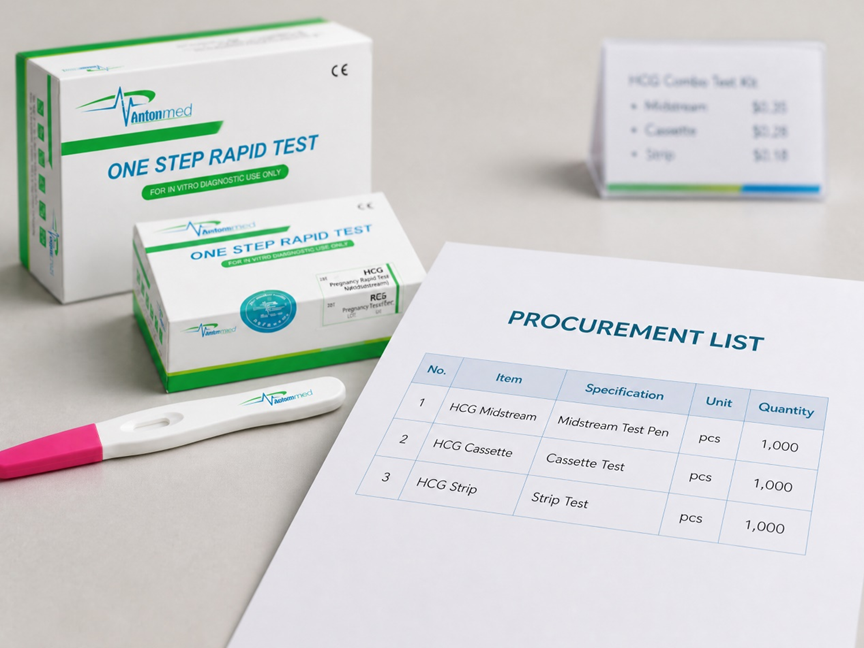
One of the most useful questions to ask is surprisingly simple: Does the company manufacture the test itself?
There is a significant difference between a manufacturer with its own production facilities and a trading company sourcing products from different factories. A trading company may still provide a suitable product, but buyers usually have less visibility into the production process and less control over consistency when specifications need to change.
For long-term cooperation, look at the manufacturer's production environment, equipment, quality control procedures, production capacity, and experience with rapid diagnostic products.
A reliable manufacturer should also be able to explain how raw materials are controlled, how production batches are managed, and how finished products are tested before shipment. These details are much more meaningful than simply being told that a factory is "professional."
Pay Attention to Quality Management
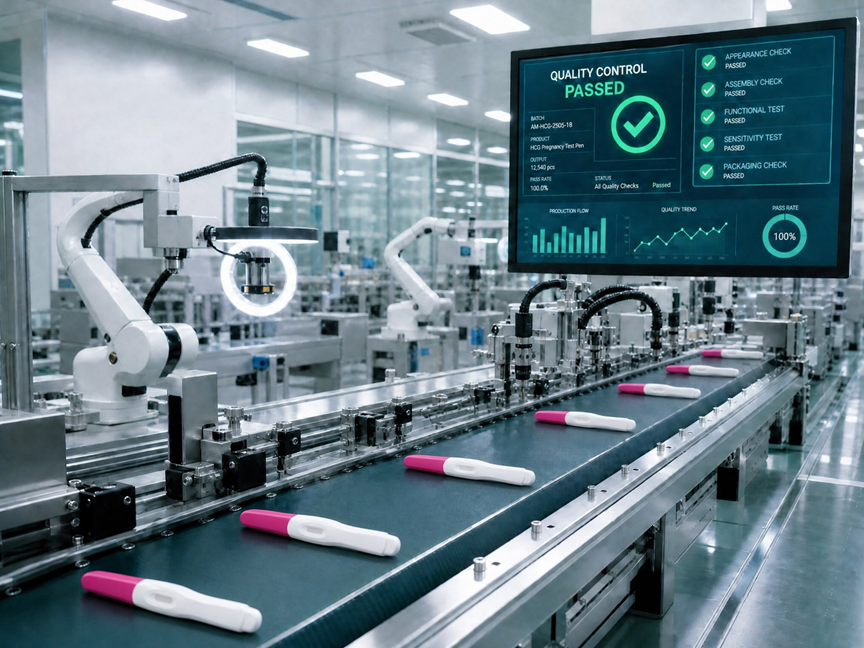
For an hCG pregnancy test, quality management is not something that should be left to the final inspection.
Quality needs to be controlled throughout the manufacturing process, from incoming materials to production, assembly, packaging, and final testing. Consistency between batches is especially important for distributors who may continue purchasing the same product for several years.
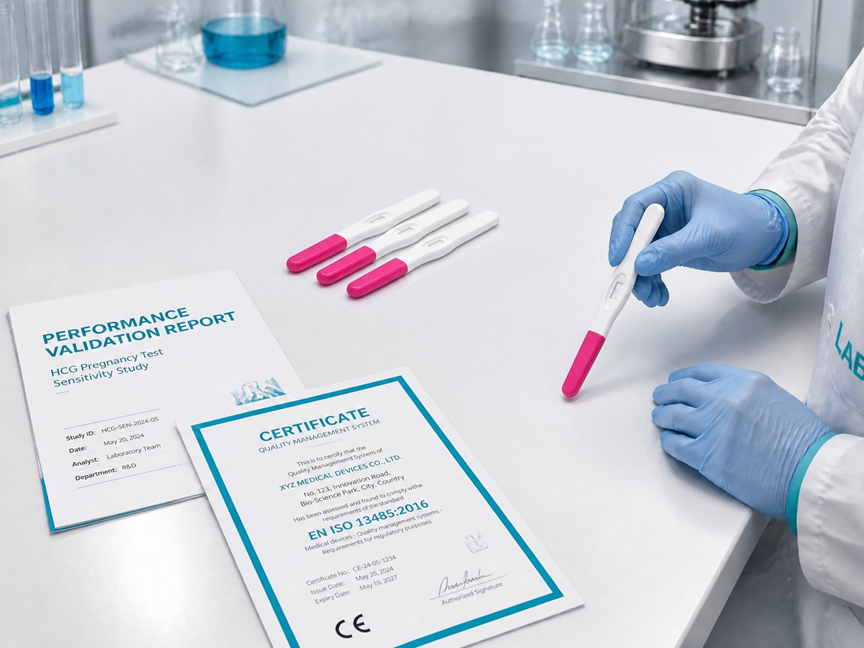
When evaluating a supplier, ask about its quality management system and the documentation available for the products you are interested in. Depending on the target market, buyers may also need technical documentation, product specifications, certificates, test reports, labeling information, and other regulatory materials.
It is also worth checking whether the manufacturer has experience supporting registration or market-entry requirements in different countries. Regulatory requirements vary by market, so a supplier familiar with international requirements can save buyers considerable time later.
Look at Test Performance, Not Just Product Appearance
Packaging can make a pregnancy test look professional, but it does not tell you much about its actual performance.
Before placing a large order, buyers should evaluate the product itself. Important factors include sensitivity, specificity, testing time, stability, ease of use, and consistency of results.
For example, if a supplier claims that an hCG test can detect low concentrations of the hormone, ask how that performance is demonstrated. Technical specifications should be supported by appropriate testing and documentation rather than marketing language alone.
It is also useful to request samples before moving forward with a bulk order. Samples allow distributors or brand owners to evaluate not only test performance but also cassette construction, strip quality, packaging, labeling, and the overall user experience.
Consider the Product Formats You Actually Need
Different markets have different preferences for pregnancy testing products.
hCG pregnancy tests are commonly available as test strips, cassettes, and midstream tests. Strips are often attractive for cost-sensitive applications and high-volume distribution. Cassette tests provide a more enclosed testing format and are widely used in professional and consumer settings. Midstream tests are designed for greater convenience and are particularly suitable for direct-to-consumer use.
A manufacturer with experience across several formats can be more useful than a supplier that only produces one type. It gives buyers greater flexibility when developing different product lines or entering new markets.
This becomes even more important for private-label businesses. A company may initially need a basic pregnancy test cassette and later want to add strips or midstream products under the same brand. Working with a manufacturer that can support multiple formats makes that expansion much easier.
OEM and Private Label Capability Can Make a Difference
For distributors and brands, manufacturing capability is only part of the equation. The ability to customize the product can be equally important.
Private-label pregnancy tests may require customized packaging, labels, instructions for use, product configurations, or other branding elements. Some buyers may also need assistance adapting packaging and documentation to meet the requirements of a particular market.
A manufacturer experienced in OEM and private-label production should be able to explain the customization process clearly, including minimum order quantities, artwork requirements, packaging options, lead times, and quality approval procedures.
Good communication at this stage can prevent problems later. A low initial quotation is not particularly useful if packaging changes take weeks to implement or every modification requires communication with several different suppliers.
Manufacturing Capacity Matters When Your Business Grows
A supplier that can handle a small sample order is not necessarily a supplier that can support a growing distribution business.
When evaluating a potential long-term partner, consider whether its production capacity is suitable for your expected purchasing volume. Lead time, raw material availability, production scheduling, and shipment consistency all become increasingly important as order quantities increase.
It is also worth asking how the manufacturer handles sudden increases in demand. Pregnancy tests are relatively simple products from a user's perspective, but maintaining consistent quality during high-volume production still requires proper process control.
For distributors, a reliable supply chain is often more valuable than finding the lowest price for the first order.
Don't Overlook Communication and After-Sales Support
Technical capability alone does not guarantee a good business relationship.
A manufacturer should be able to answer questions about specifications, samples, packaging, documentation, production schedules, and quality issues without making the buyer repeatedly chase for information.
This becomes particularly important for overseas customers. Differences in time zones, languages, regulatory requirements, and shipping arrangements can make communication more complicated. A manufacturer with an experienced international sales and technical support team can make the entire purchasing process considerably smoother.
If a supplier is difficult to communicate with before an order is placed, it is worth considering how much harder the relationship could become when there is a quality or delivery issue.
Choose a Manufacturer for Long-Term Value
The right hCG pregnancy test manufacturer should be evaluated as a potential long-term partner rather than simply a source of low-cost products.
A good supplier combines reliable product performance with controlled manufacturing, appropriate quality management, flexible product options, regulatory support, stable production capacity, and responsive communication. These factors may not always appear in the initial quotation, but they have a direct impact on the total cost and risk of doing business.
For buyers entering the pregnancy test market, the best approach is to define the requirements first, request technical information and samples, verify the manufacturer's capabilities, and only then compare commercial terms.
Antonmed is one example of a medical diagnostic manufacturer that brings these considerations together, with experience in rapid diagnostic products including hCG pregnancy tests and related fertility testing products. Its product development and manufacturing capabilities allow overseas distributors and brand owners to discuss standard products as well as OEM and private-label requirements, making it easier to build a pregnancy testing product line around the needs of different markets.
For buyers, the goal is ultimately not to find the cheapest hCG pregnancy test manufacturer. It is to find a supplier that can consistently deliver the right product, maintain quality as orders grow, and support the business long after the first shipment.

How to Choose a DOA Reagent Manufacturer
Related Article