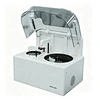


Mindray Fully Automated Biochemical Analyzer
BS-350S
Mindray BS-350S Fully Automated Biochemical Analyzer is a random-access, discrete chemistry analyzer designed for efficient and reliable routine clinical chemistry testing. With a throughput of up to 360 tests per hour and capacity for up to 100 sample positions and 100 reagent positions, it is suitable for laboratories requiring a balance between testing efficiency, automation, and operational flexibility.
Delivery:
FOB, FCA, DDP
minimum order:
1 piece
Supply Ability:
2000piece / Month
Country of Origin:
China
Stock Time:
15Day
Quantity:
Introduction
Mindray BS-350S Fully Automated Biochemical Analyzer is a random-access, discrete chemistry analyzer designed for efficient and reliable routine clinical chemistry testing. With a throughput of up to 360 tests per hour and capacity for up to 100 sample positions and 100 reagent positions, it is suitable for laboratories requiring a balance between testing efficiency, automation, and operational flexibility.
The analyzer supports multiple analytical methods, including end-point, fixed-time, and kinetic assays, as well as colorimetric and turbidimetric testing. An optional ISE module can be configured for ion-selective electrode testing. Its 12-wavelength optical system covering 340–800 nm, together with automatic cuvette washing and temperature control, helps maintain consistent analytical performance during routine operation.
The BS-350S also supports whole-blood HbA1c testing, online reagent loading, multiple reagent sets for a single test parameter, and enzyme linearity extension, providing laboratories with greater flexibility for different testing requirements.
The analyzer supports multiple analytical methods, including end-point, fixed-time, and kinetic assays, as well as colorimetric and turbidimetric testing. An optional ISE module can be configured for ion-selective electrode testing. Its 12-wavelength optical system covering 340–800 nm, together with automatic cuvette washing and temperature control, helps maintain consistent analytical performance during routine operation.
The BS-350S also supports whole-blood HbA1c testing, online reagent loading, multiple reagent sets for a single test parameter, and enzyme linearity extension, providing laboratories with greater flexibility for different testing requirements.
Features
Efficient Routine Chemistry Testing
The BS-350S supports colorimetric and turbidimetric assays, while an optional ISE module enables ion-selective electrode testing. Three analytical modes—end-point, fixed-time, and kinetic methods—cover common clinical chemistry applications.
The BS-350S supports colorimetric and turbidimetric assays, while an optional ISE module enables ion-selective electrode testing. Three analytical modes—end-point, fixed-time, and kinetic methods—cover common clinical chemistry applications.
With 12 wavelengths ranging from 340 to 800 nm, the optical system is designed to support a broad range of biochemical assays. The analyzer also provides an absorbance linearity range of 0–3.5 Abs.
Flexible Sample and Reagent Management
The analyzer supports sample volumes from 2 to 35 μL, with 0.1 μL increments, helping reduce sample consumption in routine testing. Reagent volumes range from 10 to 200 μL, adjustable in 0.5 μL increments.
The analyzer supports sample volumes from 2 to 35 μL, with 0.1 μL increments, helping reduce sample consumption in routine testing. Reagent volumes range from 10 to 200 μL, adjustable in 0.5 μL increments.
Up to 100 reagent positions are available, while the reagent compartment is maintained at 2–12°C. The system also supports online reagent loading and allows multiple reagent sets to be assigned to the same test parameter, providing additional flexibility for laboratories managing different reagent requirements.
Automated Operation and Laboratory Efficiency
Automation is integrated into several key stages of the testing process. The analyzer uses automatic warm-water cuvette washing and an enclosed constant-temperature electric heating system designed for stable operation with minimal maintenance requirements.
Automation is integrated into several key stages of the testing process. The analyzer uses automatic warm-water cuvette washing and an enclosed constant-temperature electric heating system designed for stable operation with minimal maintenance requirements.
The BS-350S also supports whole-blood HbA1c testing as a standard configuration, together with enzyme linearity extension for applications requiring a wider analytical range.
Designed for Laboratory Connectivity
The system can be configured with a dedicated computer workstation and a large LCD display for daily operation and result management. Its Chinese-language operating interface is designed to simplify routine workflow for users.
The system can be configured with a dedicated computer workstation and a large LCD display for daily operation and result management. Its Chinese-language operating interface is designed to simplify routine workflow for users.
For laboratories that require digital data management, the analyzer can also be integrated with laboratory information systems according to the applicable configuration and interface requirements.
Reagent Traceability
Traceability is an important consideration in clinical chemistry testing, particularly for laboratories that need consistent reagent management and quality control. The original manufacturer's reagents are supported by a complete traceability system, helping laboratories track reagent information throughout the testing process.
Traceability is an important consideration in clinical chemistry testing, particularly for laboratories that need consistent reagent management and quality control. The original manufacturer's reagents are supported by a complete traceability system, helping laboratories track reagent information throughout the testing process.
Technical Specifications
| Instrument Type | Random-access, discrete, fully automated chemistry analyzer |
| Throughput | ≥360 tests/hour |
| Maximum Simultaneous Analytical Parameters | ≥100 parameters |
| Test Principles | Colorimetry, turbidimetry, and ion-selective electrode (ISE) method (ISE module optional) |
| Analytical Methods | End-point, fixed-time, and kinetic methods |
| Sample Positions | Up to 100 positions |
| Sample Volume | 2–35 μL, with 0.1 μL increments |
| Reagent Positions | Up to 100 positions |
| Reagent Compartment Temperature | 2–12°C |
| Reagent Volume | 10–200 μL, with 0.5 μL increments |
| Mixing Probe | 1 mixing probe |
| Reaction Cuvettes | 80 cuvettes, with a 5 mm optical path length |
| Minimum Reaction Volume | 100 μL |
| Temperature Control | Enclosed constant-temperature electric heating system, maintenance-free |
| Cuvette Washing | Automatic warm-water washing |
| Optical System | Post-monochromator system with a holographic concave diffraction grating |
| Wavelength Range | 340–800 nm, with 12 wavelengths |
| Absorbance Linearity Range | 0–3.5 Abs |
| HbA1c Testing | Standard configuration supports whole-blood HbA1c testing |
| Enzyme Linearity Extension | Supported |
| Online Reagent Loading | Supported |
| Multiple Reagent Sets per Test Parameter | Supported |
| Operating System | Fully Chinese-language user interface |
| Standard Computer Requirements | CPU ≥2.6 GHz, hard drive ≥500 GB, RAM ≥4 GB; LCD monitor ≥20 inches |
| Reagent Traceability: | Original manufacturer reagents are supported by a comprehensive traceability system |
| MOQ | 1PCS |